Finding & Vetting Chinese Suppliers — Verification Checklist
You've set up your 1688 account and learned how to search. Now comes the critical part: finding suppliers you can trust and building relationships with them.
A great product from a bad supplier is a failure. An average product from a great supplier is a success. Supplier selection is the single most important decision you'll make.
3.1 The 5 Signs of a Great Supplier
Before you contact anyone, learn to spot the winners from the listings alone.
Sign #1: Specialization
Great suppliers focus on a specific category. They don't sell "everything" — they sell one type of product deeply.
Good sign: A store that sells 50 variations of yoga mats Bad sign: A store that sells yoga mats, phone cases, kitchen knives, and pet toys
A specialized supplier:
- Knows their product inside out
- Has better quality control
- Can answer technical questions
- Usually owns their production line
Sign #2: Real Photos, Not Stock Images
This is one of the easiest checks:
- Real photos = supplier has the product in hand
- Stock/product images = supplier may be dropshipping or reselling
- Factory photos = best sign — they show their actual facility
📷 Visual Guide — Real Photos vs. Stock Photos: A real product photo typically shows the item on a factory floor, a wooden workbench, or in someone's hand — the background is unstaged and the lighting is imperfect. You can see the texture of the material, the stitching, and sometimes even factory equipment in the background. In contrast, stock/generic photos look professionally lit with pure white backgrounds, often showing the product from angles that hide details. A common pattern: if you reverse image search and the same photo appears on 50 different listings, it's a stock photo. Legitimate suppliers take their own photos, even if they're not professionally done.
Sign #3: Appropriate Pricing
Pricing tells you a lot:
- Too low: Quality is almost certainly compromised
- Too high: They're a middleman, not a factory
- In the middle of the range: Most likely direct from a manufacturer
Rule of thumb: Search for the same product from 3-5 different suppliers. If one is dramatically cheaper than the rest, there's a reason. If one is dramatically more expensive, they're reselling.
Sign #4: Responsive Customer Service
This is invisible until you contact them, but it's critical:
- Responds within 24 hours (ideally within a few hours)
- Answers questions directly (not with vague promises)
- Willing to provide samples
- Can explain their production process
Sign #5: Established Track Record
- On the platform for 3+ years
- Consistent transaction history (not just a few big spikes)
- Mix of new and repeat customers
- Positive reviews that mention specific details
3.2 How to Verify a Supplier's Business License
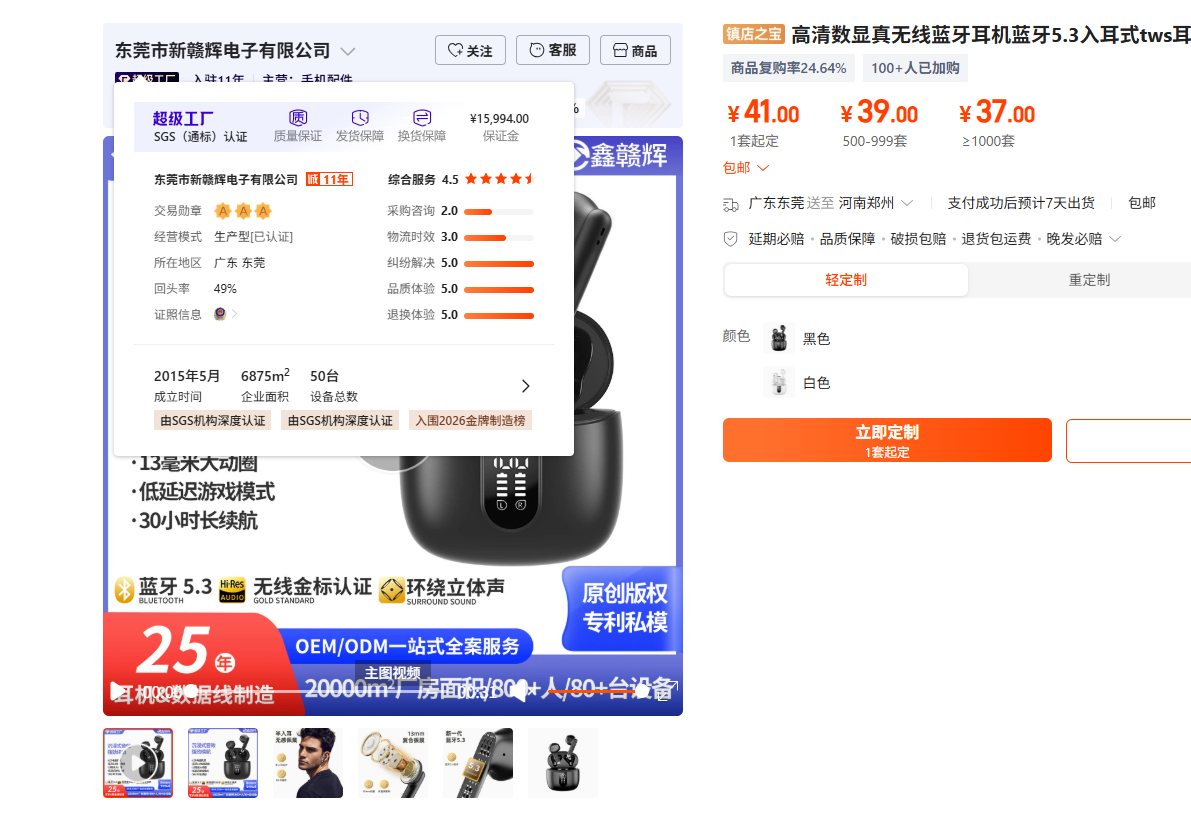
Every legitimate business registered in China has a business license (营业执照). This is the most reliable way to verify a supplier exists.
Step-by-Step
- On the supplier's store page, look for the "企业认证" badge
- Click the badge to view their certification details
- Note the Unified Social Credit Code (统一社会信用代码) — an 18-character code
What to Check
| Field on License | What to Look For |
|---|---|
| Company Name (公司名称) | Matches the store name |
| Legal Representative (法定代表人) | Real person's name |
| Registered Capital (注册资本) | Higher = more established |
| Establishment Date (成立日期) | 3+ years preferred |
| Business Scope (经营范围) | Includes your product category |
| Address (地址) | Physical location, not virtual |
Cross-Check on National Database
For extra verification (especially for large orders), check the license on China's national business credit system:
- Go to https://www.gsxt.gov.cn
- Enter the company name or credit code
- Verify the information matches
This website is in Chinese, so use Chrome's translation. But even without understanding every word, you can verify the company exists and is in good standing.
3.3 Factory vs. Trading Company — How to Tell the Difference
This is one of the most important distinctions in Chinese sourcing.
What's the Difference?
| Factory (工厂) | Trading Company (贸易公司) | |
|---|---|---|
| Owns production equipment | Yes | No |
| Controls quality | Directly | Through factory relationships |
| Price | Lowest possible | Adds a markup (15-30%) |
| English level | Often limited | Usually better |
| Product range | Narrow, specialized | Wide, varied |
| Minimum order | Higher MOQs typical | Lower MOQs possible |
Is a Trading Company Always Bad?
No. Trading companies provide real value — especially for beginners:
- They speak English
- They handle quality control
- They manage shipping
- They accept smaller orders
- They can source products you can't find
The key is knowing what you're getting. Don't pay factory prices for trading company service.
How to Spot a Trading Company on 1688
Company name contains:
- 进出口 (Import & Export)
- 贸易 (Trade/Trading)
- 国际 (International)
- 商贸 (Commerce)
They sell unrelated products: A "factory" selling both electronics and clothing is almost certainly a trading company.
Product descriptions use generic language: Factories describe their manufacturing process; trading companies describe the product.
They can't answer manufacturing questions: Ask "What's the material?" or "How is this made?" — a factory answers immediately, a trading company hesitates.
Their storefront shows "supply"而不是"manufacture": Look for words like 生产 (manufacture) vs 供应 (supply).
3.4 Preparing to Contact Suppliers
Before you reach out to any supplier, do your homework. The suppliers who take you seriously are the ones who look prepared.
What to Have Ready Before Contacting
Product Information:
- Exact product name (in Chinese, from your 1688 research)
- Target price range (based on market research)
- Estimated quantity (be realistic, not aspirational)
Your Business Profile:
- Company name (even if it's your sole proprietorship)
- What you plan to do with the products
- Where you're selling (Amazon, Shopify, etc.)
- Your target market (US, Europe, etc.)
Information to Prepare
| Information | Why Suppliers Need It |
|---|---|
| Quantity per order | Determines pricing tier |
| Shipping destination | Affects packaging and logistics |
| Quality requirements | Material, finish, tolerances |
| Timeline | When you need the product |
| Budget per unit | Helps them suggest alternatives |
Pro tip: Don't lie about your quantities. If you're ordering 100 units, say 100. Suppliers can tell when you're inflating numbers, and it damages trust. Start small, grow, and renegotiate later.
3.5 First Contact — What to Say
Your first message sets the tone. Be professional, specific, and respectful.
First Contact Template (English)
Subject: Inquiry about [Product Name] — [Your Company]
Hello,
I'm interested in your [Product Name] (Product link: [URL]).
A few questions:
- What is the factory price for quantities of [X], [Y], and [Z]?
- What is the MOQ?
- Can you provide samples? What is the sample cost?
- What is the lead time for production?
- What materials/quality level does this product use?
We are a [e-commerce brand / retail company] based in [Country], selling primarily on [Amazon / Shopify / etc.].
Looking forward to your reply.
Best regards, [Your Name] [Your Company]
First Contact Template (Chinese — Use on 1688)
Subject: 关于[Product Name]的询价
你好,
我对贵店的[Product Name]感兴趣 (产品链接: [URL])。
请问:
- 数量[X]件、[Y]件、[Z]件的批发价是多少?
- 最小起订量是多少?
- 是否提供样品?样品费多少?
- 生产周期需要多久?
- 这款产品的材质是什么?
我们在[Country]做电商,主要销售平台是[Amazon/Shopify等]。
期待您的回复。
谢谢, [Your Name]
What to Expect
- Response time: Usually within 24 hours on 1688
- Response rate: ~60-70% for first-time contacts
- Follow-up: If no response in 48 hours, send a polite follow-up
Red Flags in Supplier Responses
| Response | Concern |
|---|---|
| "Yes, we can do any price" | They don't know their costs — middleman behavior |
| "Minimum order 1 piece" | Unrealistic for wholesale — probably reselling |
| Vague answers to specific questions | They may not know the product |
| Pushy, wants payment immediately | High scam risk |
| Only accepts Western Union or MoneyGram | Very high scam risk |
| Can't provide samples | They may not have the product |
3.6 Ordering Samples
Always order samples before placing a bulk order. This is non-negotiable.
Why Samples Matter
- Verify product quality matches the listing
- Check packaging for your needs
- Test the product yourself
- Take your own photos for your store
- Check shipping time from this supplier
- Verify the supplier is legitimate
How to Request Samples
- Ask for the sample cost — Most suppliers charge for samples
- Negotiate sample fees — Ask if the sample cost is refundable with your first order
- Cover shipping — You pay shipping; they send the sample
- Request 1-3 units — Enough to test without overspending
Sample Request Template
Hello,
I'd like to order a sample of [Product Name] to verify quality before placing a bulk order.
- What is the sample cost (including shipping to [Country])?
- Is the sample fee refundable with my first order?
- How long will it take to arrive?
Once I confirm the quality, I'll place an order for [Quantity] units.
Thank you, [Your Name]
What to Check When You Receive the Sample
- Appearance: Does it look like the photos?
- Material: Is it the quality you expected?
- Functionality: Does it work properly?
- Packaging: Is it suitable for retail or do you need custom packaging?
- Smell: Some cheap products have chemical odors — check this
- Weight: Does it match the listing? (Important for shipping costs)
- Measurements: Are the dimensions as stated?
📋 Practical Tip — Using the Checklist: Print the sample evaluation scorecard below or copy it into a notes app. When your sample arrives, go through each check one by one. Lay the product on a clean table under good lighting. Compare it side-by-side with the listing photos on your phone or computer. Take your own photos for reference. If you're checking multiple products from different suppliers, create a separate scorecard for each — this makes side-by-side comparison much easier when deciding who to order from.
Sample Evaluation Scorecard
| Check | Pass/Fail | Notes |
|---|---|---|
| Matches listing photos | ||
| Material quality acceptable | ||
| Functions as expected | ||
| Packaging condition | ||
| No unusual odors | ||
| Weight accurate | ||
| Dimensions accurate | ||
| Would you buy this yourself? |
If 6+ out of 8 pass → proceed to order. If 4-5 pass → discuss improvements with the supplier. If fewer than 4 pass → find another supplier.
3.7 Quality Control During Production
Once you place an order, you need to ensure the factory delivers what you agreed on.
Inline Inspection (During Production)
For larger orders (500+ units), consider hiring a third-party inspection company to check production mid-way. They can catch issues early when they can still be fixed.
Pre-Shipment Inspection (PSI)
This happens when the order is 80-100% complete. An inspector visits the factory to check:
- Quantity matches the order
- Quality matches the approved sample
- Packaging meets your specifications
- No defective units in the batch
Third-Party Inspection Services
| Company | Best For | Approx. Cost |
|---|---|---|
| SGS | Large orders, full certification | $300-500 per inspection |
| Bureau Veritas | Consumer goods, electronics | $250-450 per inspection |
| Intertek | General products | $250-400 per inspection |
| QIMA | Small-medium orders, fast service | $200-350 per inspection |
| AsiaInspection | Budget-friendly, startups | $150-300 per inspection |
For orders under $2,000, third-party inspection may not be cost-effective. Instead, ask the supplier to send you photos and videos of the finished goods before shipping.
DIY Quality Checks
If you're not using an inspection service:
- Ask for photos of the finished goods
- Request a video call to see the production line
- Ask for random samples from the batch (not specially selected ones)
- Check packaging in the photos — does it look professional?
3.8 Using Alibaba as a Backup Verification Tool
Here's a powerful technique that most sourcing guides miss:
Use Alibaba to verify 1688 suppliers.
Here's how:
- Find a product on 1688
- Copy the supplier's company name
- Search for the same company on Alibaba.com
- If they're on Alibaba too, you can:
- See their Alibaba verification status
- Check their response rate
- Read reviews from international buyers
- Communicate in English
What This Tells You
| Scenario | What It Means |
|---|---|
| On 1688 + Alibaba (verified) | Legitimate supplier, experienced with exports |
| On 1688 only | Likely a domestic-only factory — may not do international shipping |
| On Alibaba with good reviews | Lower risk, proven export experience |
| On Alibaba with bad reviews | Red flag — check what went wrong |
Pro tip: If a supplier is on both platforms, ask for the 1688 price, not the Alibaba price. You might get a better deal.
Module 3 Summary
- Look for specialization, real photos, fair pricing, and good communication
- Always verify business licenses through 1688's certification system
- Know whether you're dealing with a factory or a trading company — both have their place
- Prepare before contacting suppliers — have your information ready
- Use the message templates provided in this chapter for your first contact
- Always order samples before bulk orders — this is not optional
- Use third-party inspections for larger orders
- Cross-check 1688 suppliers on Alibaba for extra verification
Ready to move on? Module 4 covers the most practical skill — communication and negotiation — including 20+ Chinese message templates you can copy and paste.
This is one module of the full China Sourcing Suite
Get all 13 modules plus 2 bonus guides — 205 pages of actionable content for sourcing products from China.
Buy the Full Bundle — $19